> ## Documentation Index
> Fetch the complete documentation index at: https://portkey-docs-feat-rerank-documentation.mintlify.site/llms.txt
> Use this file to discover all available pages before exploring further.
# Hugging Face
Portkey provides a robust and secure gateway to facilitate the integration of various Large Language Models (LLMs) into your applications, including all the text generation models supported by [Huggingface's Inference endpoints](https://huggingface.co/docs/api-inference/index).
With Portkey, you can take advantage of features like fast AI gateway access, observability, prompt management, and more, all while ensuring the secure management of your LLM API keys through a [virtual key](/product/ai-gateway/virtual-keys) system.
Provider Slug. `huggingface`
## Portkey SDK Integration with Huggingface
Portkey provides a consistent API to interact with models from various providers. To integrate Huggingface with Portkey:
### 1. Install the Portkey SDK
Add the Portkey SDK to your application to interact with Huggingface's API through Portkey's gateway.
```sh theme={"system"}
npm install --save portkey-ai
```
```sh theme={"system"}
pip install portkey-ai
```
### 2. Initialize Portkey with the Virtual Key
To use Huggingface with Portkey, [get your Huggingface Access token from here](https://huggingface.co/settings/tokens), then add it to Portkey to create the virtual key.
```js theme={"system"}
import Portkey from 'portkey-ai'
const portkey = new Portkey({
apiKey: "PORTKEY_API_KEY", // defaults to process.env["PORTKEY_API_KEY"]
virtualKey: "VIRTUAL_KEY", // Your Huggingface Virtual Key
huggingfaceBaseUrl: "HUGGINGFACE_DEDICATED_URL" // Optional: Use this if you have a dedicated server hosted on Huggingface
})
```
```py theme={"system"}
from portkey_ai import Portkey
portkey = Portkey(
api_key="PORTKEY_API_KEY", # Replace with your Portkey API key
virtual_key="VIRTUAL_KEY", # Replace with your virtual key for Huggingface
huggingface_base_url="HUGGINGFACE_DEDICATED_URL" # Optional: Use this if you have a dedicated server hosted on Huggingface
)
```
```py theme={"system"}
from openai import OpenAI
from portkey_ai import PORTKEY_GATEWAY_URL, createHeaders
client = OpenAI(
api_key="HUGGINGFACE_ACCESS_TOKEN",
base_url=PORTKEY_GATEWAY_URL,
default_headers=createHeaders(
api_key="PORTKEY_API_KEY",
provider="huggingface",
huggingface_base_url="HUGGINGFACE_DEDICATED_URL"
)
)
```
```js theme={"system"}
import OpenAI from "openai";
import { PORTKEY_GATEWAY_URL, createHeaders } from "portkey-ai";
const client = new OpenAI({
apiKey: "HUGGINGFACE_ACCESS_TOKEN",
baseURL: PORTKEY_GATEWAY_URL,
defaultHeaders: createHeaders({
provider: "huggingface",
apiKey: "PORTKEY_API_KEY",
huggingfaceBaseUrl: "HUGGINGFACE_DEDICATED_URL"
}),
});
```
### **3. Invoke Chat Completions with** Huggingface
Use the Portkey instance to send requests to Huggingface. You can also override the virtual key directly in the API call if needed.
```js theme={"system"}
const chatCompletion = await portkey.chat.completions.create({
messages: [{ role: 'user', content: 'Say this is a test' }],
model: 'meta-llama/Meta-Llama-3.1-8B-Instruct', // make sure your model is hot
});
console.log(chatCompletion.choices[0].message.content);
```
```py theme={"system"}
chat_completion = portkey.chat.completions.create(
messages= [{ "role": 'user', "content": 'Say this is a test' }],
model= 'meta-llama/meta-llama-3.1-8b-instruct', # make sure your model is hot
)
print(chat_completion.choices[0].message.content)
```
```py theme={"system"}
chat_completion = client.chat.completions.create(
messages = [{ "role": 'user', "content": 'Say this is a test' }],
model = 'meta-llama/meta-llama-3.1-8b-instruct', # make sure your model is hot
)
print(chat_completion.choices[0].message.content)
```
```js theme={"system"}
async function main() {
const chatCompletion = await client.chat.completions.create({
model: "meta-llama/meta-llama-3.1-8b-instruct", // make sure your model is hot
messages: [{ role: "user", content: "How many points to Gryffindor?" }],
});
console.log(chatCompletion.choices[0].message.content);
}
main();
```
```py theme={"system"}
chat_completion = client.chat.completions.create(
messages = [{ "role": 'user', "content": 'Say this is a test' }],
model = 'meta-llama/meta-llama-3.1-8b-instruct', # make sure your model is hot
)
print(chat_completion.choices[0].message.content)
```
## [Using Virtual Keys](https://app.portkey.ai/virtual-keys)
Virtual Keys serve as Portkey's unified authentication system for all LLM interactions, simplifying the use of multiple providers and Portkey features within your application. For self-hosted LLMs, you can configure custom authentication requirements including authorization keys, bearer tokens, or any other headers needed to access your model:
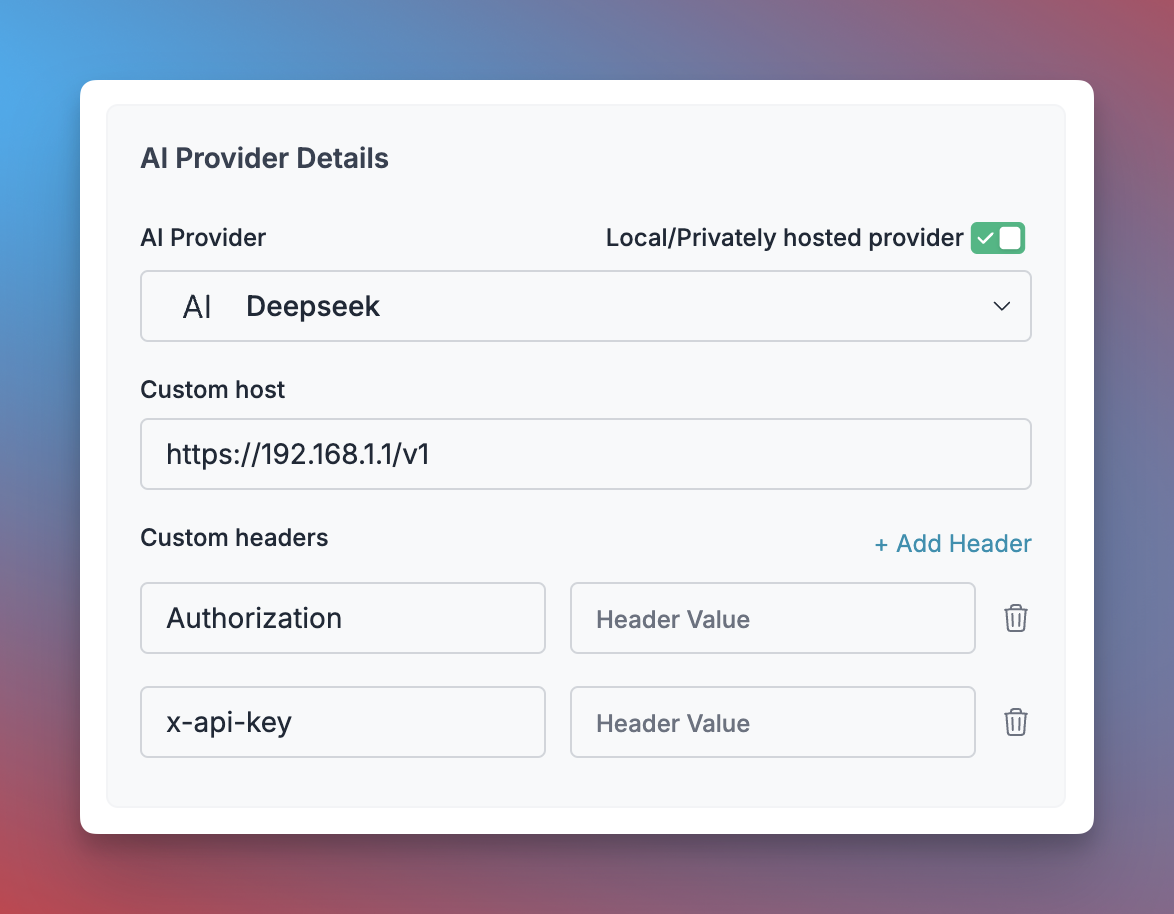 1. Navigate to [Virtual Keys](https://app.portkey.ai/virtual-keys) in your Portkey dashboard
2. Click **"Add Key"** and enable the **"Local/Privately hosted provider"** toggle
3. Configure your deployment:
* Select the matching provider API specification (typically `OpenAI`)
* Enter your model's base URL in the `Custom Host` field
* Add required authentication headers and their values
4. Click **"Create"** to generate your virtual key
You can now use this virtual key in your requests:
```js theme={"system"}
const portkey = new Portkey({
apiKey: "PORTKEY_API_KEY",
virtualKey: "YOUR_SELF_HOSTED_LLM_VIRTUAL_KEY"
async function main() {
const response = await client.chat.completions.create({
messages: [{ role: "user", content: "Bob the builder.." }],
model: "your-self-hosted-model-name",
});
console.log(response.choices[0].message.content);
})
```
```python theme={"system"}
portkey = Portkey(
api_key="PORTKEY_API_KEY",
virtual_key="YOUR_SELF_HOSTED_LLM_VIRTUAL_KEY"
)
response = portkey.chat.completions.create(
model="your-self-hosted-model-name",
messages=[
{"role": "system", "content": "You are a helpful assistant."},
{"role": "user", "content": "Hello!"}
]
print(response)
)
```
For more information about managing self-hosted LLMs with Portkey, see [Bring Your Own LLM](/integrations/llms/byollm).
# Next Steps
The complete list of features supported in the SDK are available on the link below.
You'll find more information in the relevant sections:
1. [Add metadata to your requests](/product/observability/metadata)
2. [Add gateway configs to your Huggingface requests](/product/ai-gateway/configs)[ requests](/product/ai-gateway/configs)
3. [Tracing Huggingface requests](/product/observability/traces)
4. [Setup a fallback from OpenAI to Huggingface APIs](/product/ai-gateway/fallbacks)
1. Navigate to [Virtual Keys](https://app.portkey.ai/virtual-keys) in your Portkey dashboard
2. Click **"Add Key"** and enable the **"Local/Privately hosted provider"** toggle
3. Configure your deployment:
* Select the matching provider API specification (typically `OpenAI`)
* Enter your model's base URL in the `Custom Host` field
* Add required authentication headers and their values
4. Click **"Create"** to generate your virtual key
You can now use this virtual key in your requests:
```js theme={"system"}
const portkey = new Portkey({
apiKey: "PORTKEY_API_KEY",
virtualKey: "YOUR_SELF_HOSTED_LLM_VIRTUAL_KEY"
async function main() {
const response = await client.chat.completions.create({
messages: [{ role: "user", content: "Bob the builder.." }],
model: "your-self-hosted-model-name",
});
console.log(response.choices[0].message.content);
})
```
```python theme={"system"}
portkey = Portkey(
api_key="PORTKEY_API_KEY",
virtual_key="YOUR_SELF_HOSTED_LLM_VIRTUAL_KEY"
)
response = portkey.chat.completions.create(
model="your-self-hosted-model-name",
messages=[
{"role": "system", "content": "You are a helpful assistant."},
{"role": "user", "content": "Hello!"}
]
print(response)
)
```
For more information about managing self-hosted LLMs with Portkey, see [Bring Your Own LLM](/integrations/llms/byollm).
# Next Steps
The complete list of features supported in the SDK are available on the link below.
You'll find more information in the relevant sections:
1. [Add metadata to your requests](/product/observability/metadata)
2. [Add gateway configs to your Huggingface requests](/product/ai-gateway/configs)[ requests](/product/ai-gateway/configs)
3. [Tracing Huggingface requests](/product/observability/traces)
4. [Setup a fallback from OpenAI to Huggingface APIs](/product/ai-gateway/fallbacks)